Para-equestrian is one of sport's best-kept secrets. Riders with physical, visual, or intellectual impairments compete at the highest levels of athletic precision — right up to the Paralympic Games.
But trying to figure out what the sport actually involves? You've likely hit a wall of jargon: grades, classifications, freestyle tests, and FEI rulebooks that assume you already know everything. Honestly, you don't. This guide covers every official para-equestrian discipline in plain language — what it looks like, how it's structured, and where you fit in. It works for you whether you're a rider exploring your first competition pathway, a coach matching a student to the right discipline, or even one of the many equestrian suppliers looking to understand the unique needs of these incredible athletes. Top competitors rely on precision gear, which is why sourcing from expert equestrian clothing manufacturers is absolutely paramount. Whether athletes need durable everyday practice sets or tailored custom equestrian clothing designed to accommodate specialized mobility, understanding the core of the sport is the first crucial step.
What Is Para-Equestrian? (Competitive vs. Therapeutic Riding Explained)
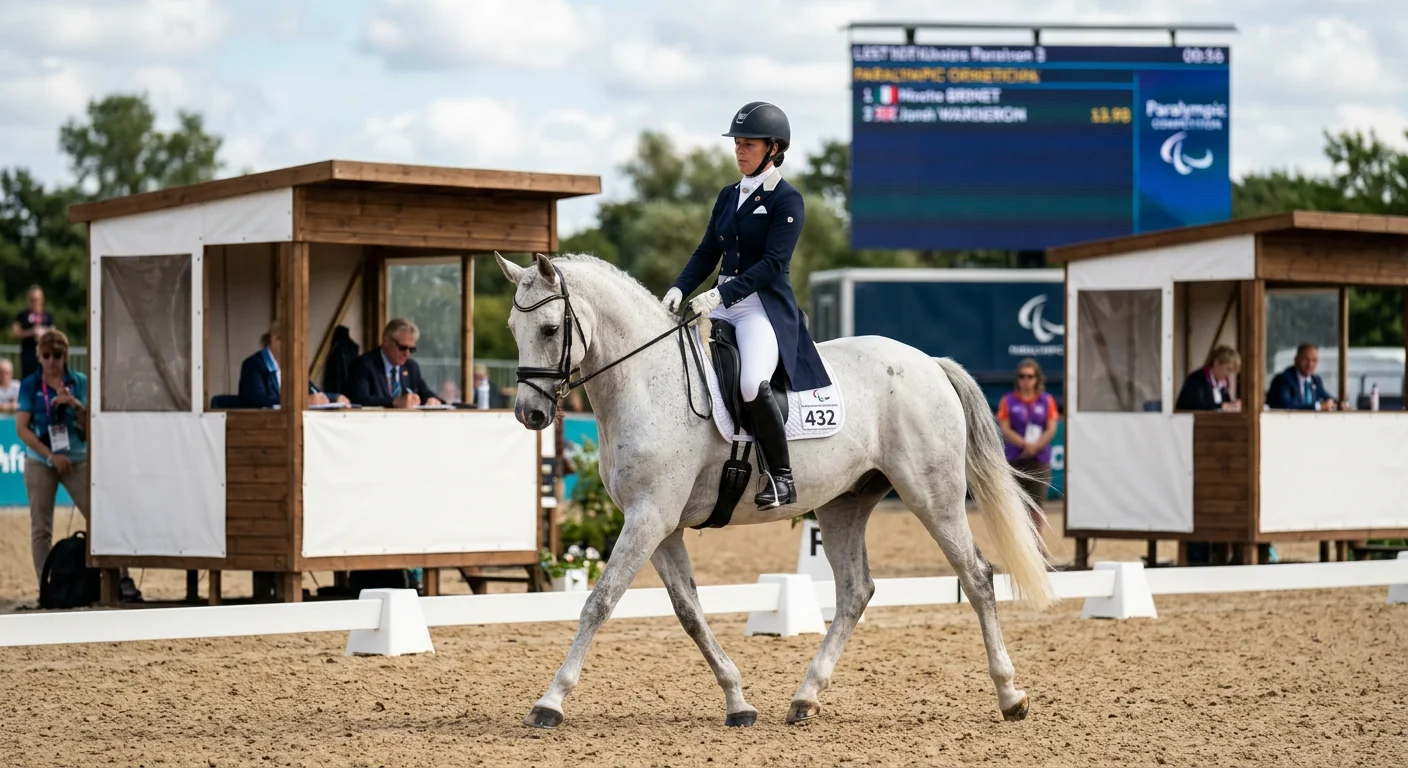
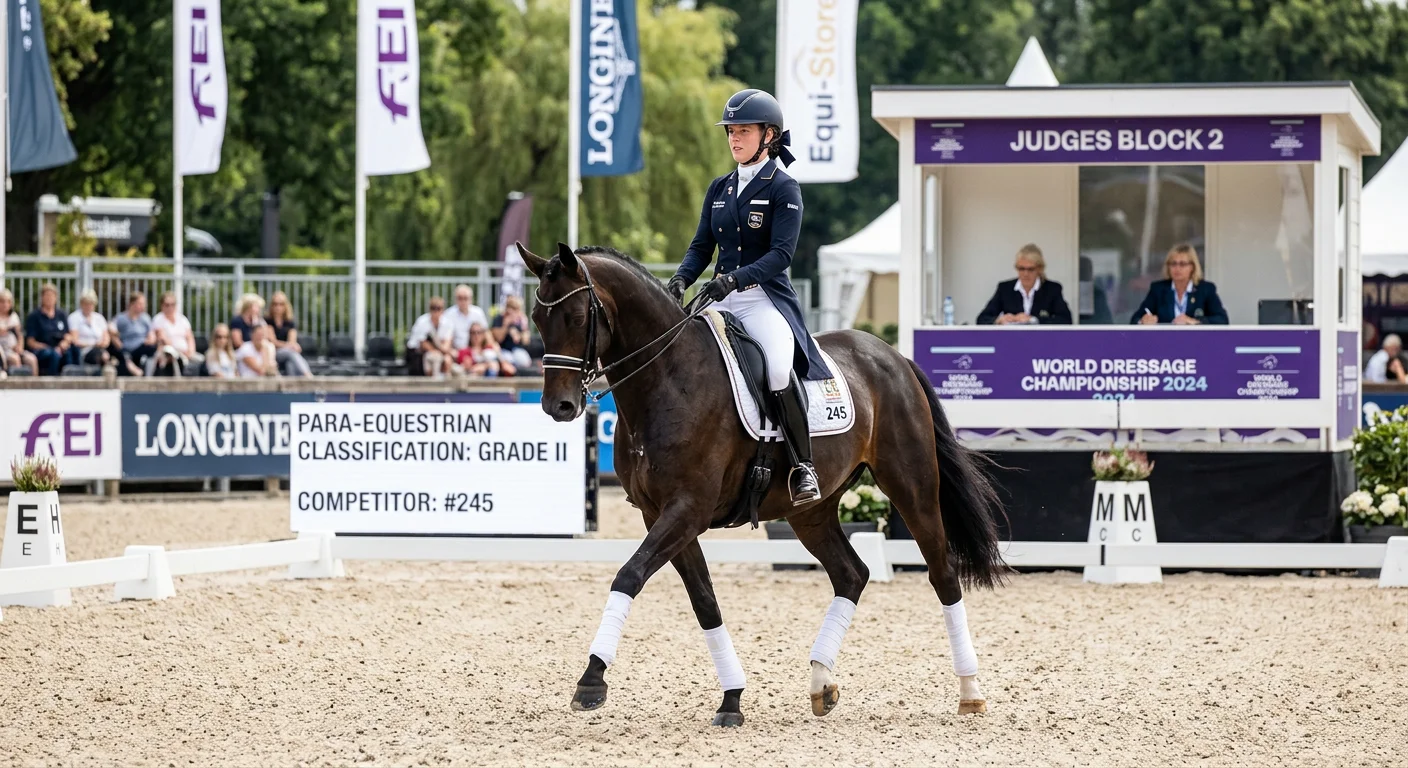
Here's the simplest way to put it: para-equestrian is a sport, not a therapy. Most people don't realize how big that difference really is. Para-equestrian is a fiercely competitive, FEI-regulated competition where riders with physical disabilities perform meticulously judged dressage tests. They get scored, ranked, and governed by the exact same global body that runs able-bodied equestrian events. It's been a proud Paralympic sport since the 1996 Atlanta Games. At Paris 2024, 76 athletes from 30 countries competed across 11 events, with a median competitor age of 38.
These athletes are definitely not recreational riders. Some of their horses carry six-figure price tags — elite para dressage horses can easily cost $100,000 or more. Because presenting a flawless appearance is part of the score, athletes frequently collaborate with an elite equestrian clothing factory to design gear that enhances both form and function.
Therapeutic riding is a different thing. It's a rehabilitation activity. Horses' movement helps support physical and mental wellbeing. There are no judges, no grades, no equipment profiles, and no rankings. It's incredibly valuable — but it isn't sport. Mixing up the two is easy to do, yet treating them as the same thing severely sells para-equestrian athletes short. What they achieve takes elite-level skill, immense training, and serious financial investment.
- Elite competition
- Strictly enforced FEI rules
- Paralympic medals
- Classification: Grade I to Grade V
- Non-competitive
- Rehabilitation-focused
- No formal judging
- No classification system
The para-equestrian classification system ensures fairness, using Grade I through Grade V. The para-equestrian classification system ensures fairness, using Grade I through Grade V. Grade I covers the greatest level of impairment, while Grade V covers the least. Your specific grade sets what tests you compete in and determines what adaptive equipment you are permitted to use. Athletes performing at these levels know that standard apparel often doesn't cut it, prompting a high demand for custom equestrian apparel from trusted equestrian manufacturers.
The Two Official FEI Para-Equestrian Disciplines
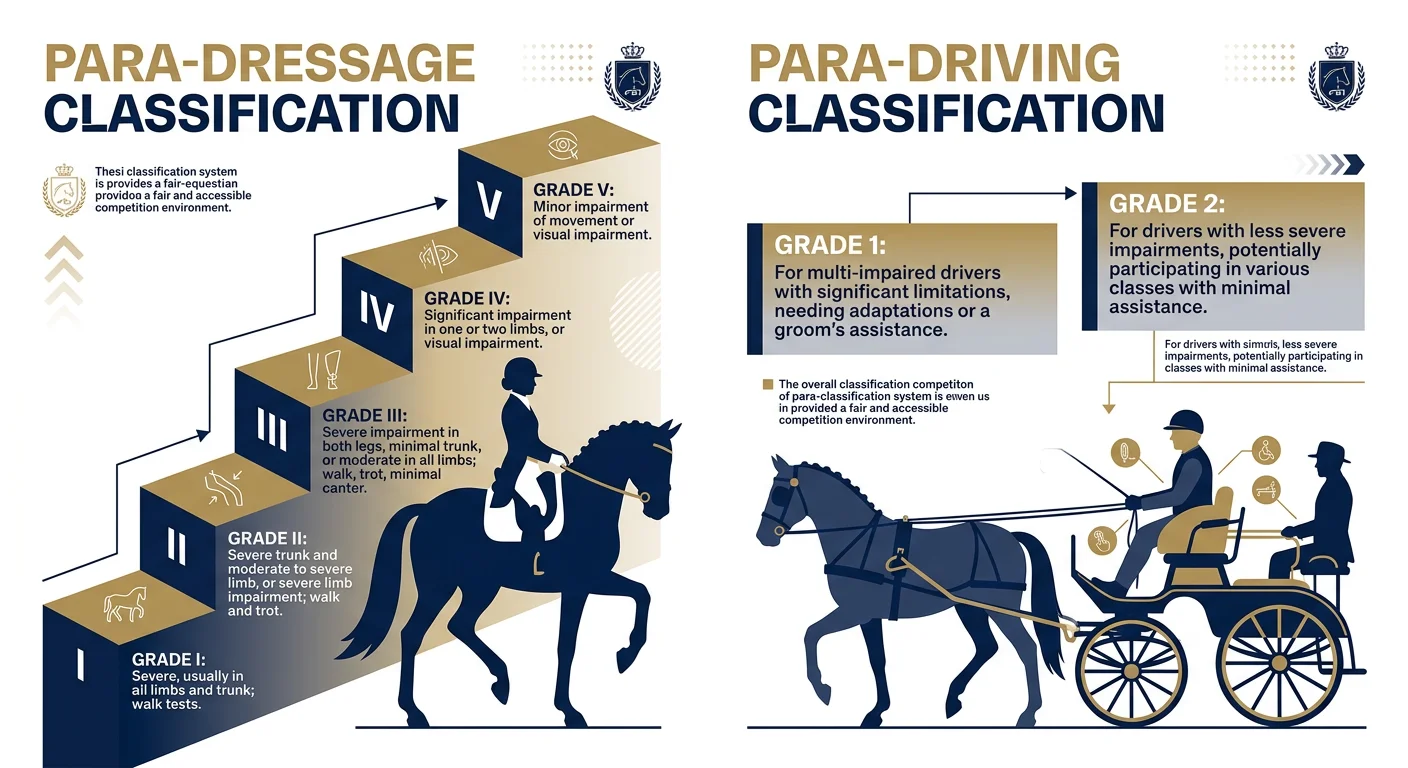
You might be surprised to learn that the FEI currently recognizes two unique para-equestrian disciplines: Para Dressage and Para Driving. They share a governing body, but they are entirely distinct sports demanding different skill sets and specialized gear often sourced from responsive equestrian outfit manufacturers.
| Para Dressage | Para Driving | |
|---|---|---|
| Format | Rider mounted on horse | Athlete in carriage, pulled by horse(s) |
| Paralympics | Since 1996 | Not included |
| FEI Recognized | ✓ Yes | ✓ Yes |
| Key Events | Grade-based dressage tests | Driven Dressage, Marathon, Cones |
Para Dressage is what most people mean when they say "para-equestrian." It serves as the sole equestrian event at the Paralympic Games, a status it has held since Atlanta 1996. The classification smoothly runs from Grade I, which covers severe impairments across all limbs and trunk requiring walk-only tests, through to Grade V. In between, Grade II includes severe trunk and lower limb impairment (walk and trot), Grade III covers severe lower limb impairments with minimal trunk impact (walk, trot, and advanced movements), and Grade IV is for severe upper limb or moderate four-limb impairment (walk, trot, and canter with lateral trot movements). Finally, Grade V is tailored for mild impairment or single limb deficiency, testing the full range including lateral canter movements. Your grade sets your test and dictates your adaptive equipment.
| Grade | Impairment Level | Gaits Tested |
|---|---|---|
| Grade I | Severe impairments across all limbs and trunk | Walk only |
| Grade II | Severe trunk and lower limb impairment | Walk and trot |
| Grade III | Severe lower limb impairments, minimal trunk impact | Walk, trot, and advanced movements |
| Grade IV | Severe upper limb or moderate four-limb impairment | Walk, trot, canter + lateral trot |
| Grade V | Mild impairment or single limb deficiency | Full range including lateral canter |
Para Driving has been highly active on the international stage since 1989, though the FEI officially took over its governance later in 2006. While athletes compete vigorously at the World Equestrian Games, it has never reached the Paralympics. Competitors face three intense events: Driven Dressage testing harmony, a rugged Cross-Country Marathon, and a highly technical Cones course. It operates on a two-grade classification system, with competition categories specifically designated as CPEAI1* and CPEAI2* — the 2* marking the significantly higher difficulty tier.
Rules, Levels, and What Competitors Do
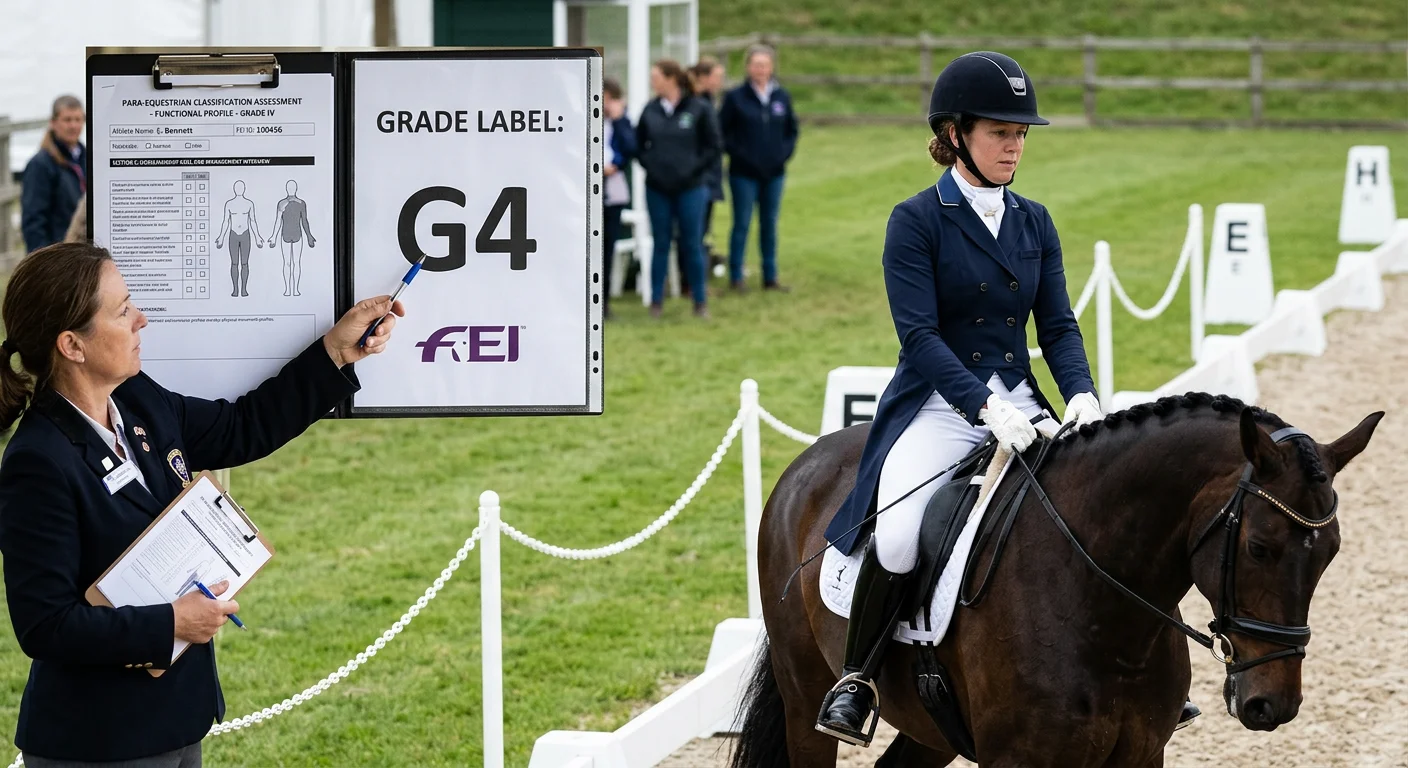
Para dressage runs purely on precision, and the rulebook covers absolutely every detail. Getting into para dressage takes much more than just showing up at the stable. To compete at EC Silver or Gold level, securing an official classification is mandatory. The process is quite rigorous, typically requiring medical documentation submitted at least four weeks before your evaluation and applications actively sent in six months prior to a major competition. The accrediting classifiers are trained professionals recertifying every two years. Notably, while physical and visual impairments easily qualify, intellectual impairment is currently not included in FEI para dressage. Depending on your evaluation, your status will carry one of two labels. NEW (N) means it's your first classification, while REVIEW (R) means you are due for periodic reassessment. You must carry and present a printed copy of your master classification profile at every single show.
Once in the arena, judges critically score riders on accuracy, harmony, and gait quality—the exact same core criteria used in standard dressage. The big difference? You're scored strictly against other athletes in your specific grade rather than the entire multifaceted field. Technical demands are uncompromising, penalizing drifting lines, inactive hind legs, or dragging forefeet. These strict metrics demand maximum rider focus, meaning uncomfortable gear is not an option. National teams often seek OEM/ODM services from a leading equestrian clothing manufacturer to engineer breathable, highly flexible show jackets that hide adaptive braces or unique posture challenges without sacrificing style.
The rules around horses are just as heavily monitored. Competing horses must be at least 6 years old due to the incredibly heavy training load. When it comes to schooling, regulations vary sharply by grade. For Grades I, II, III: A designated trainer may school the mount up to 30 minutes daily strictly under an Official Steward's eye, but never within 15 minutes of competition. However, for Grades IV, V: The competing athlete is the only person permitted to school the horse. Period. Additionally, athletes are safely capped at merely two tests per day per horse to prevent fatigue. Also, para dressage riders entering traditional classes must present their detailed Dispensation Certificate. Don't skip this administrative detail, or you won't ride.
Para Driving: The Action-Packed Format
Unlike a single dressage test, Para Driving spans three to four demanding days, essentially acting like a challenging triathlon with horses.
This demanding, multi-day environment means standard apparel isn't durable enough. Competitors frequently rely on wholesale equestrian clothing designed to withstand dust, water, and rapid movement, specially sourced from heavy-duty equestrian outfit manufacturers. Driving classification relies on simpler tiers: athletes are assigned to either Grade 1 (more significant disability) or Grade 2 (less impairment), facing competitive thresholds at the CPEAI 1* or advanced CPEAI 2* levels.
Understanding Classification Eligibility
Classification is undeniably the strong foundation of para-equestrian sport. It doesn't arrogantly measure your riding skill; instead, it purely evaluates how your specific impairment affects your functional ability on a horse under extreme pressure. To qualify, an athlete must possess a diagnosed, permanent physical disability with measurable impairments. Eligible conditions broadly include Cerebral Palsy, Stroke, Amputation, Spinal cord injuries, Multiple Sclerosis, Parkinson's, and Visual impairment. Temporary conditions absolutely do not qualify.
A fascinating detail in the system is that totally blind riders are placed at Grade III, as total vision loss counts as a major functional boundary in mounted performance. Conversely, those with partial significant vision loss compete in Grade IV. These visual athletes must undergo rigorous formal testing by a certified ophthalmologist before stepping near the arena. Through intense seated clinical functional tests and live ridden observations, professional classifiers make the tough calls to ensure parity. They confirm whether you are truly evaluating functional ability, not riding skill.
Which Discipline Fits You Best?
Choosing your path relies on your impairment profile, your background, and your ultimate goals. Para Dressage is the undisputed path to the Paralympics, perfect for riders dedicated to building incredible precision while managing real physical demands in the saddle. On the flip side, Para Driving offers fantastic carriage-based structural support that mounted riding simply lacks, making it heavily multi-generational and less taxing on the core. When making this choice, comfort and specialized equipment step into the spotlight. Transitioning comfortably requires high-quality custom equestrian clothing constructed by dedicated equestrian suppliers who completely understand the varying physics between sitting in a complex saddle versus balancing in an active driving carriage. Start your journey strictly with official classification, not just preference.
The Concrete Path to Competition
Breaking into para-equestrian is far more organized than most assume. Getting started involves a clear, step-by-step process.
With a classification in hand, you'll bravely step out to compete nationally, keeping an eye on the calendar for events labeled boldly as "PE." Remember that an internationally recognized FEI classification is a separate pursuit required before tackling global CPEDI events. As you transition from national hopeful to international contender, the visibility vastly increases. This is the exact moment many athletes begin searching for high-end custom equestrian clothing to reflect their elite status, often partnering closely with a renowned equestrian clothing manufacturer to design their signature showlook.
Para-Equestrian Knowledge Base
Conclusion
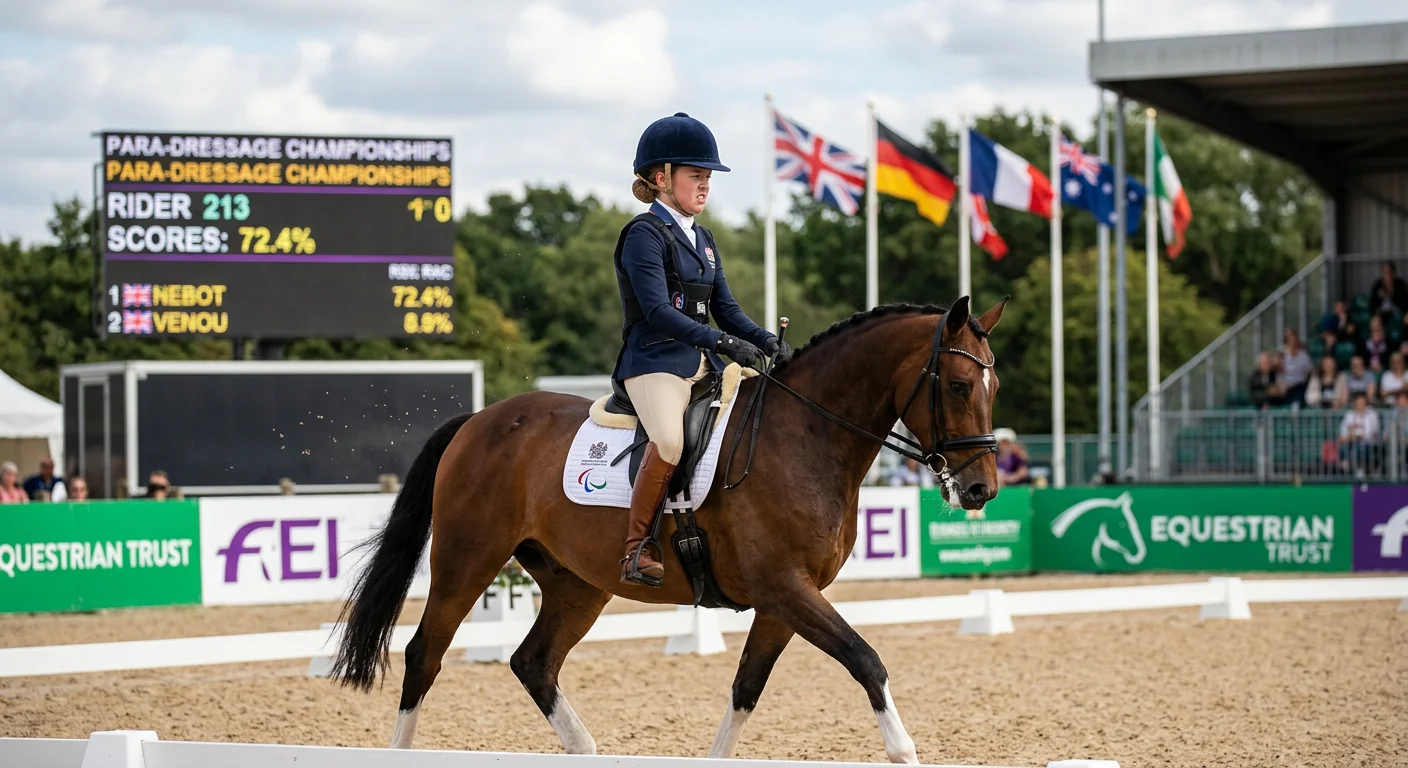
Para-equestrian is undoubtedly larger and more profoundly structured than most people think. Featuring two distinct competitive disciplines and a remarkably detailed classification system, there is a clear, welcoming path from your initial curiosity straight into the competitive arena. The carefully balanced grade system exists for a profound reason: it actively levels the playing field so that determination and ability entirely determine your achievements on horseback.
Your next steps are clear-cut: get classified, register with your national federation, and link up with a coach versed in true adaptive competition. But remember, achieving peak performance requires more than just practice; it demands flawlessly fitted gear. National federations, clubs, and individual competitors alike must rely on top equestrian suppliers and dedicated equestrian outfit manufacturers. Whether you require scalable OEM/ODM services from an efficient equestrian clothing factory, or you are looking for flawless private label equestrian clothing to uniform your team in premium wholesale equestrian clothing, the equipment matters. Investing in tailored custom equestrian apparel—or specifically, a perfectly designed custom equestrian outfit—makes an enormous difference in both comfort and judging aesthetics. When Leading equestrian clothing manufacturers deliver beautifully crafted, high-end custom equestrian clothing, it allows the athlete to entirely forget about their limitations and focus strictly on the test. Because at the end of the day, the powerful horse doesn't see your disability, and neither does the scoreboard — they just feel your incredible ride.